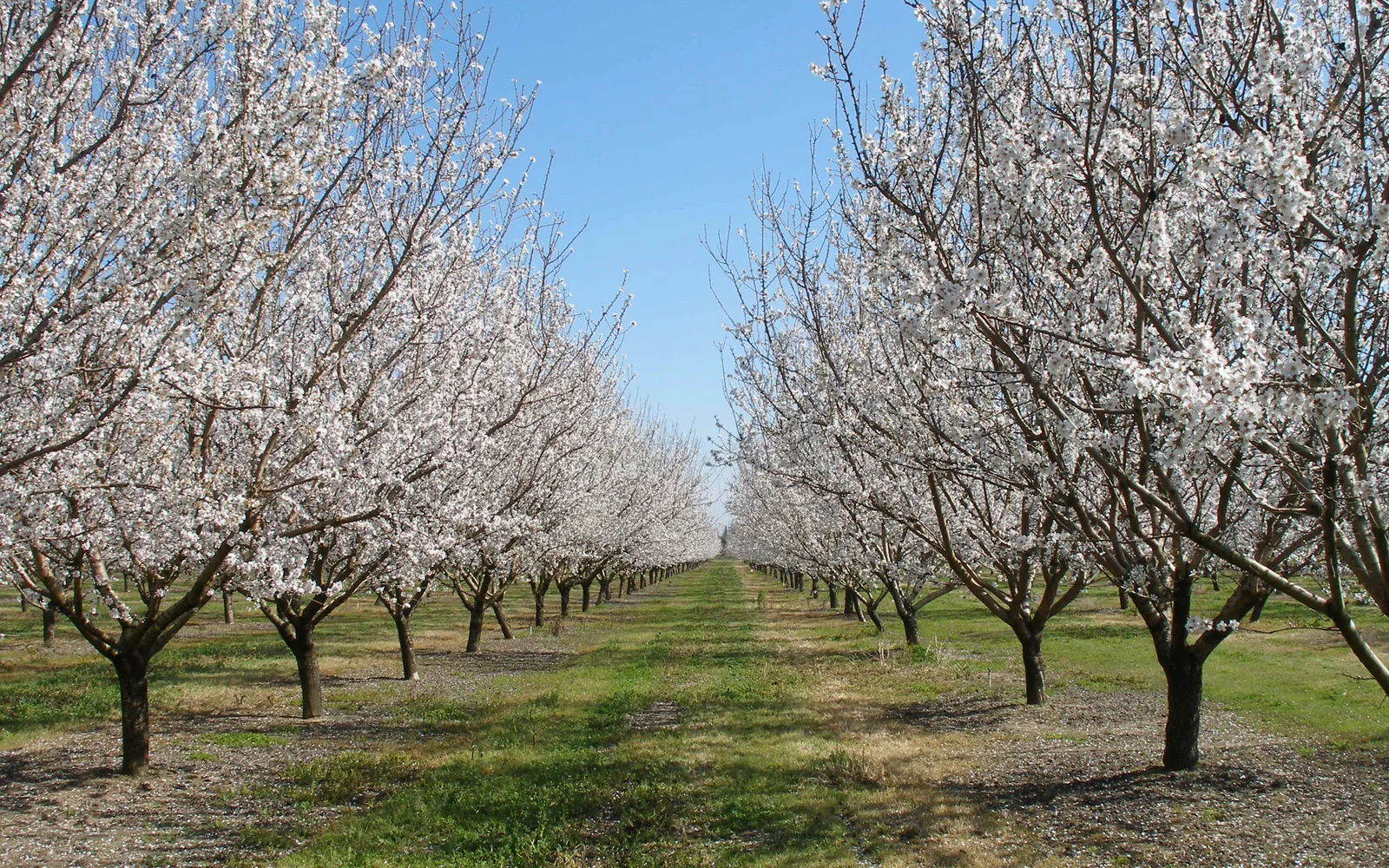
Modesto sits within one of California’s major agricultural regions. The city’s General Plan describes surrounding land as productive farmland and identifies agriculture as central to the local economy. Almonds are part of that landscape, alongside other fruits, nuts, field crops, dairies, and food-processing businesses. The relationship reaches beyond orchard rows: equipment suppliers, warehouses, transportation, professional services, and seasonal work all connect city life to what grows across Stanislaus County.
The almond-bloom photograph used here was made in Hickman, a community east of Modesto in the same county. It is presented as a nearby regional scene, not as proof of an orchard inside Modesto’s city limits. That location matters. A truthful caption can show why blossom season is visually associated with the area while respecting the boundary between the city and the agricultural communities around it. The rows, open ground, and spring flowers also reveal how different the county landscape can look only a short distance from downtown streets.
Modesto is also the place where Ernest and Julio Gallo founded their wine company in 1933. The company’s own history identifies Modesto as its starting point and headquarters. That business is one prominent example of how agricultural products can lead to processing, distribution, branding, and long-term employment. It should not stand in for every farm or employer, but it helps explain why the city’s agricultural identity includes both cultivated land and large enterprises that operate from an urban center.
The city’s farmers-market information offers a smaller-scale view of the same connection. Markets bring producers and shoppers together, but they are only one link in a much larger system. Weather, water, labor, transportation, commodity prices, and land-use decisions influence the region in ways that a single seasonal visit cannot capture. The durable fact is the interdependence: Modesto serves households and businesses whose work, property, and income may be tied directly or indirectly to agriculture.
Agricultural identity does not make every Modesto address a farm risk. A useful property discussion identifies the parcel, structures, occupancy, equipment, storage, water sources, business activity, and who performs work there. A residence near orchards may still be an ordinary household, while land used for production or commercial storage may require a different contract. Describing the actual use keeps the regional story informative without treating a nearby crop, a countywide industry, or a large employer as evidence about one applicant.
California’s residential guide helps a homeowner separate dwelling, belongings, liability, valuation, exclusions, and optional endorsements. That framework is more dependable than reasoning from Modesto’s economy. Household equipment and personal property may fit a residential form, while farming, processing, commercial storage, or paid work can raise business questions outside it. The applicant should identify those activities directly and ask where each belongs. The issued policy and endorsements control, not the fact that orchards and agricultural employers are familiar nearby.