Modesto’s connection to American Graffiti begins with George Lucas, who grew up in the city and drew on the cruising culture he knew. City records describe Modesto as the filmmaker’s birthplace and identify local teenage cruising as inspiration for the story. The film arrived in 1973, and its fictional setting preserved the look and rhythm of a California car culture that Modesto residents recognized. That history is more specific than a generic classic-car theme: it ties a nationally known film to nights spent circling familiar commercial streets.
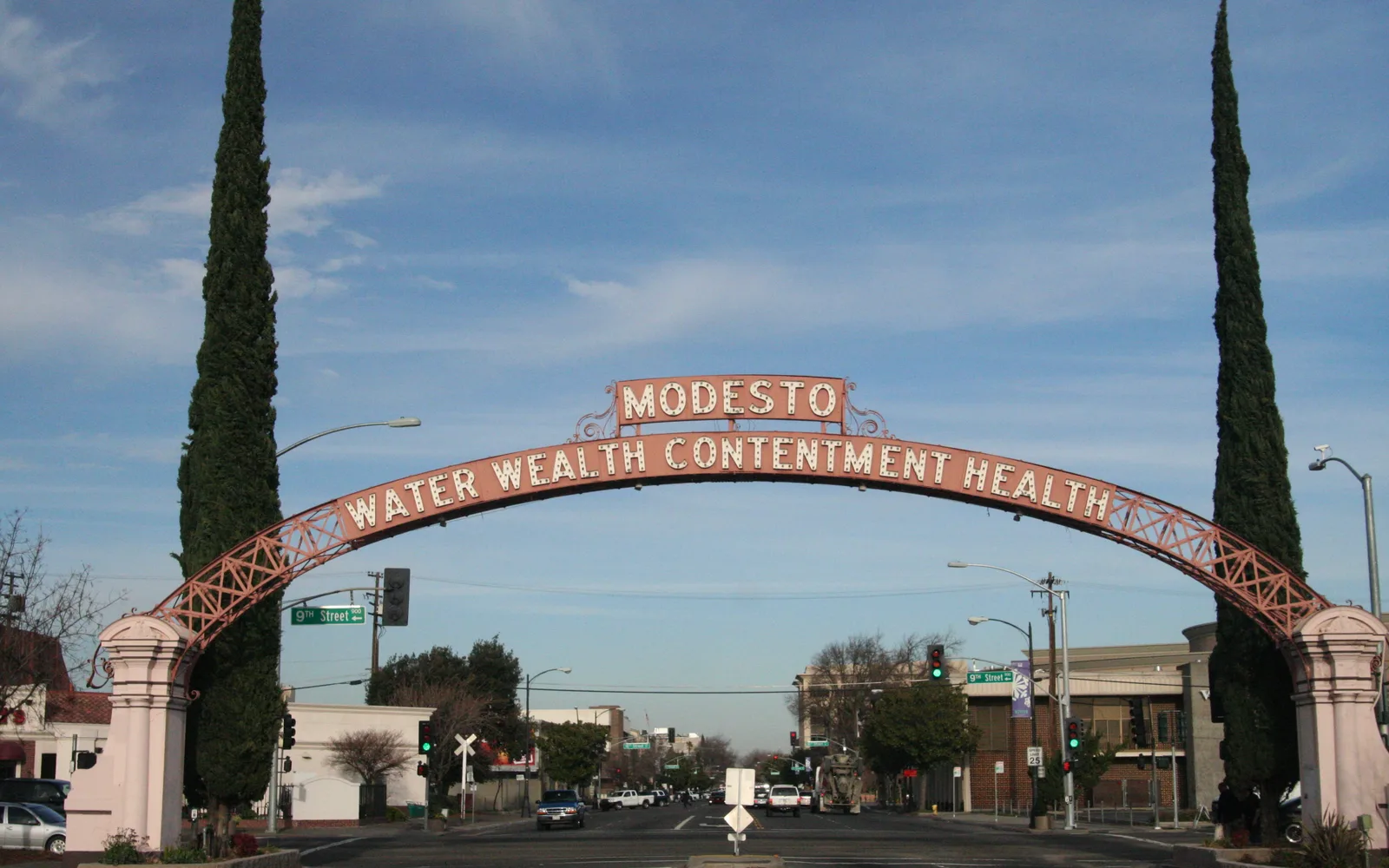
The Modesto Arch offers a useful visual threshold for that story. Erected in 1912, the landmark spans I Street near downtown and carries the city motto. The arch predates the postwar cruising era, yet it helps locate the civic landscape around which later memories formed. Streets, signs, storefronts, and gathering places changed over time, while the arch remained a recognizable point in the city. Its presence makes the film connection feel rooted in an actual place rather than in a movie set detached from local history.
Modesto later turned the association into an annual civic tradition. The city’s Graffiti Summer information describes events built around classic cars, music, and cruising memories. Official ordinance history also records that a local cruising ban enacted in the 1990s was repealed decades later. Those records show that cruising was not merely an aesthetic. It raised practical questions about traffic, street use, public safety, and how the city wanted to manage a popular custom.
For visitors and residents, the careful way to tell the story is to separate documented history from nostalgia. Lucas’s Modesto upbringing and the city’s influence are supported by municipal sources. Individual cars, routes, and personal memories vary. A photograph of the arch or a restored vehicle can illustrate the broader setting without proving that a particular object appeared in the film. That distinction keeps the local feature accurate while leaving room for the many personal versions of Graffiti-era Modesto.
Graffiti-era imagery can start an auto-insurance conversation, but it cannot answer one. A driver reviewing coverage should identify the actual vehicle, modifications, mileage, garaging, household drivers, commuting, exhibition, and occasional-event use. A restored coupe used only for shows presents different facts from a daily commuter, even when both appear at the same civic celebration. Keeping the cultural story separate from the application prevents nostalgia about Modesto’s cruising past from becoming an unsupported assumption about a present vehicle.
California’s auto guide supplies a useful checklist for the Graffiti connection: liability requirements, optional physical-damage protection, uninsured-motorist choices, rating information, and the need to compare contracts. Those categories still must be applied to the actual driver and car. A film-inspired celebration does not establish whether a restored vehicle has agreed-value treatment, whether occasional-event driving is permitted, or how modifications are valued. The issued policy and endorsements control those answers.